It’s gone midnight in the UK, the house is quiet, and somewhere in America a college career is about to change forever.
The NFL Draft isn’t just an event. It’s the moment everything in college football builds towards.
Every late night game, every Pro Day rep, every debate about potential versus production leads here.
Saturdays are about proving yourself.
The Draft is where that proof gets valued.
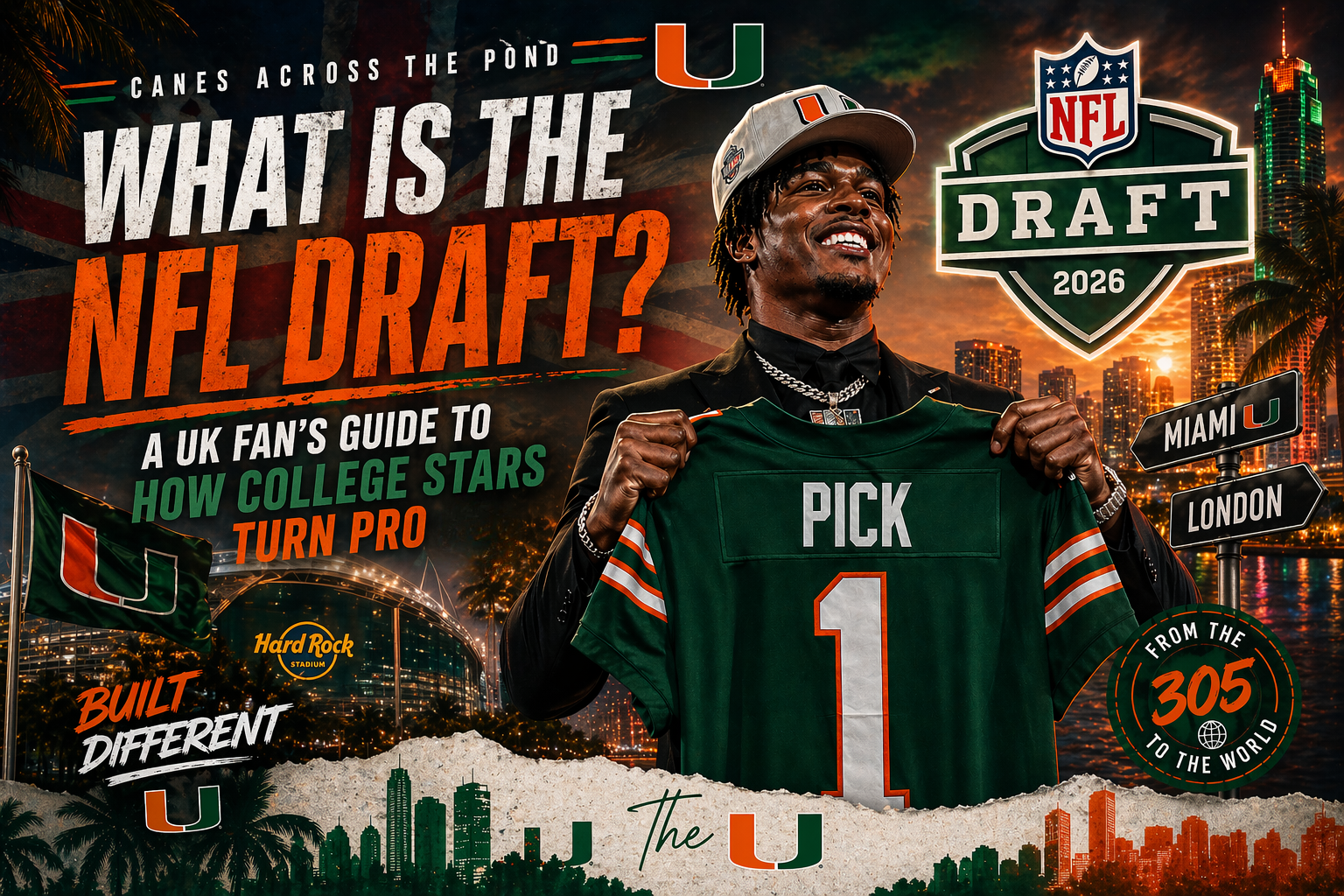
What Is the NFL Draft?
The NFL Draft is the annual event where all 32 teams in the National Football League select eligible college football players to join their franchises.
Held each April, the Draft runs across three days and seven rounds, with teams taking turns to pick players in a set order.
On the surface, it’s simple. In reality, it’s one of the most important mechanisms in American sport, shaping the future of teams and careers in real time.
How the Draft Order Works
The order is designed to create competitive balance across the league.
The team with the worst record from the previous NFL season picks first. The Super Bowl winner picks last. Everyone else falls in between based on performance.
For UK fans used to promotion and relegation, it feels backwards. But the logic is simple. The worst teams get first access to the best talent.
How Many Rounds Are There?
The Draft consists of seven rounds, with each team originally allocated one pick per round.
In reality, trades mean some teams end up with more selections while others have fewer. Picks themselves become assets, moved around in pursuit of better players or future opportunities.
By the end of the Draft, more than 250 players will have been selected. Some will become stars. Others will fight just to make a roster.
Who Is Eligible for the NFL Draft?
Players become eligible for the NFL Draft three years after leaving high school.
This is why most prospects declare after their junior season, although some choose to stay longer to improve their draft stock.
It’s always a risk. One more season could raise your value. It could also end everything before it begins.
What Happens Before the Draft?
The Draft itself is only the final step. The real evaluation process happens in the months before it.
The NFL Combine
An invite-only event where players are tested physically and mentally in front of scouts, coaches, and executives. Here’s our full guide to the NFL Combine if you want to understand exactly what goes on.
Pro Days
Colleges host their own showcase events, giving players another opportunity to perform in a familiar environment. Read our guide to Pro Days to see how they fit into the bigger picture.
For Miami Hurricanes players, Pro Day is where The U reminds everyone what it looks like when South Florida talent is fully developed.
Interviews and Visits
Teams assess more than just performance. Personality, mindset, and cultural fit all play a role in draft decisions.
Why the NFL Draft Matters
The Draft is where potential becomes investment.
High picks carry expectation and pressure. Late-round picks arrive with uncertainty but often more to prove.
For college programmes, the Draft is a reflection of success. The more players you send to the league, the stronger your reputation becomes.
The Miami Hurricanes and the Draft
At its peak, Miami wasn’t just sending players to the NFL. It was defining it.
Names like Michael Irvin (1st round, 1988), Ray Lewis (1st round, 1996), Ed Reed (1st round, 2002), and Sean Taylor (1st round, 2004) didn’t just get drafted. They became the standard.
Those names aren’t just Miami legends. They are Pro Football Hall of Famers who defined entire eras of the NFL.
Miami’s influence runs even deeper. Warren Sapp (1st round, 1995) dominated the defensive line. Andre Johnson (1st round, 2003) became one of the most consistent receivers of his generation. Frank Gore, although drafted later, built a career defined by longevity and production.
More recently, that legacy has continued. Cam Ward emerged as a No.1 overall pick, reinforcing what Miami has always been about at its best, producing players good enough to be the first name called on draft night.
The Golden Era That Built The U
Miami’s relationship with the NFL Draft isn’t just strong, it’s historic. From the late 1980s through the early 2000s, The U became one of the most dominant talent pipelines the sport has ever seen.
The 2001 national championship team alone produced 17 future first-round picks, one of the most talent-rich rosters in college football history.
Players like Ed Reed, Andre Johnson, Clinton Portis, Willis McGahee, Jonathan Vilma, and Vince Wilfork all came through the same programme and went on to become major NFL figures.
Under coaches like Jimmy Johnson, Dennis Erickson, and later Larry Coker, Miami built a system rooted in South Florida talent and NFL-level standards.
That era didn’t just produce draft picks. It set the expectation. At Miami, getting players into the NFL wasn’t the goal. It was the baseline.
What About Undrafted Players?
Not every player hears their name called.
Undrafted free agents can still sign with teams and earn their place through training camp. Some of the league’s most respected players have taken this route.
Why UK Fans Should Care
If you’re watching college football from the UK, the Draft is where everything connects.
The players you’ve stayed up late to follow suddenly become part of the NFL teams you watch on Sundays.
It turns late-night viewing into long-term investment.
Keep exploring College Football Basics: You might also enjoy our guides to the NFL Combine, National Signing Day and redshirt years.
The Last Word from Across the Pond
The NFL Draft isn’t just about who gets picked. It’s about what it proves.
It proves which programmes develop talent. Which players turned potential into production. And which teams believe they’ve found something worth building around.
For Miami, it has always meant one thing.
If The U is sending players to the league, it’s usually heading somewhere serious.
Want to see exactly how this year’s class shapes up? Read our full 2026 Miami NFL Draft breakdown — nine picks, four UDFAs, and every Cane heading to training camp.
