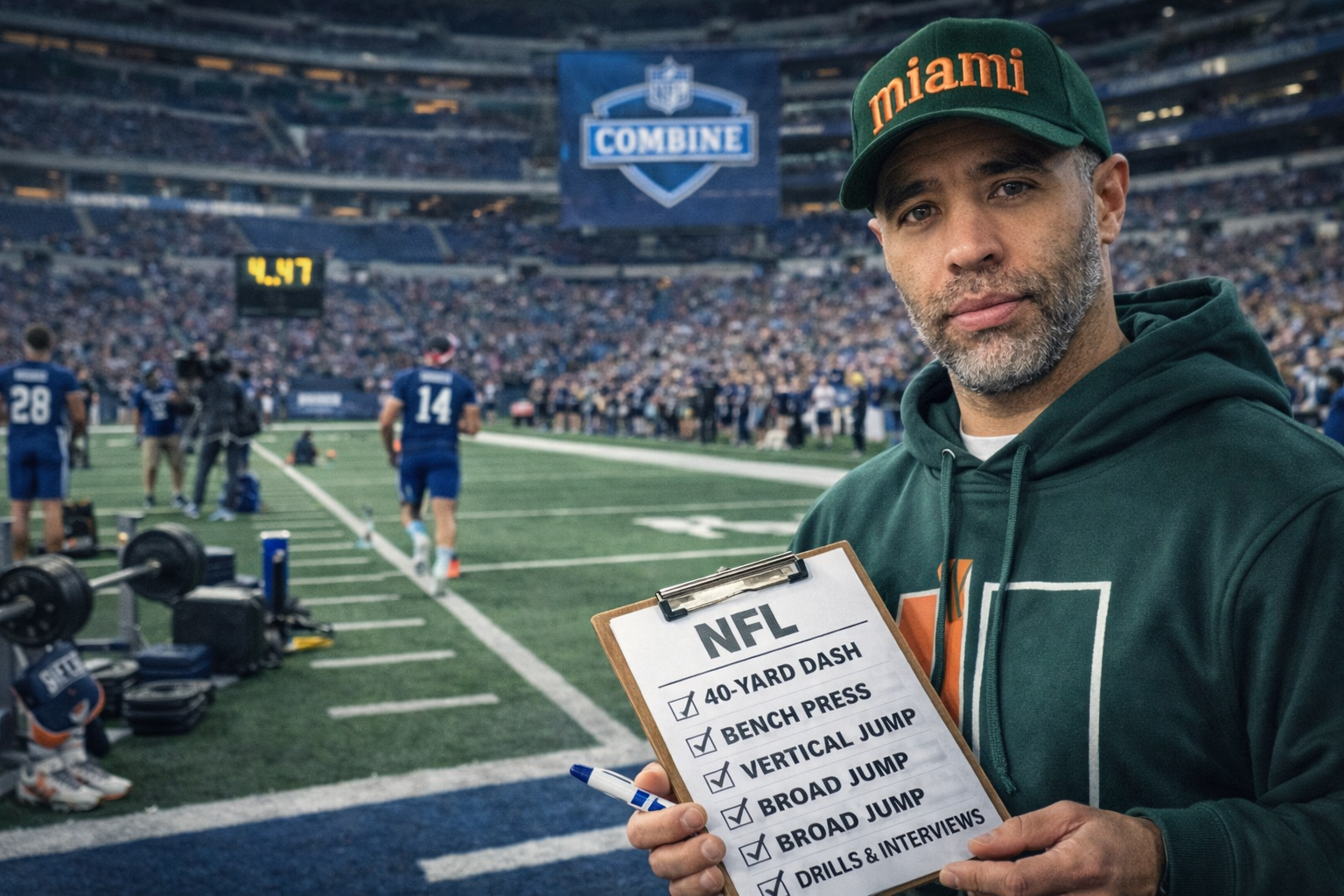
Every February, while most UK sports fans are focused on football, rugby or Six Nations weekends, something significant is happening in Indianapolis.
No crowd noise.
No marching bands.
No late-night kick-offs.
Just stopwatches, measuring tapes and front office executives with clipboards.
The NFL Combine.
For those of us who follow college football from across the pond, this is where Saturday careers are translated into Sunday potential.
If you are new to the sport, here is a complete guide to what the Combine is, how it works, and why it matters year after year.

What Is the NFL Combine?
The NFL Combine is an invitation-only evaluation event held annually in Indianapolis.
Each year, roughly 300 of the top draft-eligible college football players are invited to participate. Invitations are based on scouting grades, production, position value and team interest.
The event allows all 32 NFL teams to evaluate prospects under identical conditions.
Think of it as a centralised, standardised job interview for professional football.
But it is not just a workout.
It includes:
- Athletic testing
- Position-specific drills
- Comprehensive medical examinations
- Psychological and cognitive testing
- Formal and informal interviews
Attendance alone signals that a player is firmly on the draft radar.
A Brief History
The modern Combine began in the 1980s when NFL teams agreed to centralise scouting medical and testing processes rather than travel individually to campuses.
Indianapolis became the permanent home because of its indoor stadium, facilities and logistical convenience.
Since then, it has grown into a televised event, with prime-time coverage and millions watching players run forty-yard dashes in real time.
It has become part science experiment, part spectacle.
Where It Fits in the Football Calendar
For newer fans, especially in the UK, context helps.
The annual football timeline looks like this:
Autumn
College regular season
December and January
Conference championships and bowl games
February
NFL Combine
March and April
Pro Days and team visits
Late April
NFL Draft
The Combine is the bridge between college production and professional projection.
It is where evaluation shifts from film room to measurable data.
To understand what comes before all of this, our guide to National Signing Day and college football recruiting explains how players get to this stage in the first place.
The Athletic Testing: What Actually Matters?
The drills are what most fans recognise.
The 40-Yard Dash
The headline event.
Measures straight-line speed.
Elite benchmarks:
- Wide receivers and cornerbacks: sub-4.40 seconds
- Running backs: sub-4.50
- Offensive linemen: around 5.00 seconds
But the most important split is often the 10-yard split, which measures acceleration rather than top speed.
For edge rushers and defensive tackles, that first 10 yards can define draft status.
Vertical Jump
Measures lower-body explosiveness.
Elite numbers:
- Skill players: 35–40+ inches
- Edge rushers: 34+ inches
It reflects power generation and burst.
Broad Jump
Another explosiveness test.
Anything above 10 feet for skill players draws attention.
Bench Press
225 pounds for maximum repetitions.
Particularly relevant for:
- Offensive linemen
- Defensive linemen
It is not just about strength. It is about endurance and upper-body stability.
Three-Cone Drill
Measures change of direction and balance.
Elite times:
- Sub-6.8 seconds for skill players
This drill often separates technically sound athletes from purely straight-line fast ones.
Short Shuttle
Tests lateral movement and agility.
Critical for:
- Linebackers
- Defensive backs
- Offensive linemen
In today’s NFL, lateral quickness is essential.
Quarterbacks: A Different Evaluation
Quarterbacks do not run the forty for spectacle.
Their spotlight moment is the throwing session.
Scouts evaluate:
- Ball velocity
- Placement
- Timing
- Footwork
- Mechanics
But interviews matter more for quarterbacks than any other position.
Teams want to understand:
- Football IQ
- Command of protections
- Leadership style
- Ability to process complex information
For QBs, the Combine is as much about whiteboard sessions as it is about arm strength.

Kirby Lee/USA Today Sports/Reuters
The Medical Element
This is the least glamorous but often the most influential part.
Players undergo comprehensive medical examinations.
Teams review:
- Injury history
- Structural concerns
- Surgical outcomes
A previously undisclosed medical issue can significantly impact draft positioning.
Sometimes more than a slow forty ever could.
Does the Combine Really Change Draft Stock?
Film is still king.
What a player did across 12 or 13 games carries more weight than one sprint in shorts.
But the Combine can:
- Confirm elite traits
- Ease doubts about athletic ceilings
- Raise concerns if testing disappoints
A player projected as a mid-round pick can climb with exceptional testing.
Equally, a top prospect can face scrutiny if measurable numbers fall below expectation.
It does not replace tape.
But it shapes narratives.
Why It Matters for College Programmes
For programmes like Miami, the Combine is about more than individual ambition.
It is about development.
Consistent Combine representation signals:
- Strong strength and conditioning
- High-level coaching
- NFL-readiness
- National credibility
When Miami sends players from offence, defence and multiple position groups, it reflects roster-wide development rather than isolated star power.
In recruiting, one question always surfaces:
Can this programme get me to the league?
Combine invitations are part of that answer.
Combine vs Pro Day
Not every draft prospect is invited.
Those who are not can showcase themselves at their university’s Pro Day.
Pro Days:
- Take place on campus
- Use familiar facilities
- Often produce faster times
The Combine provides standardised conditions.
That consistency makes comparisons cleaner.
NFL evaluators rely on both.
Why UK Fans Should Care
If you are watching college football from the UK, the Combine explains a lot.
It clarifies:
- Why athletic measurables are discussed constantly
- Why draft boards shift in February and March
- Why recruiting focuses on “NFL traits”
It is the moment where college potential becomes professional data.
And it reinforces how closely college football and the NFL are linked.
Those late-night Saturdays you commit to?
They continue here.
The Last Word from Across the Pond
The NFL Combine may look clinical.
Rows of executives. Stopwatch timers. Drill rotations.
But behind every jump and sprint is a player who has spent years developing from high school recruit to professional prospect.
For players, it is the gateway.
For programmes, it is proof of progress.
For fans watching from the UK, it is the reminder that the journey does not end in December.
It simply moves indoors.


Leave a Reply