
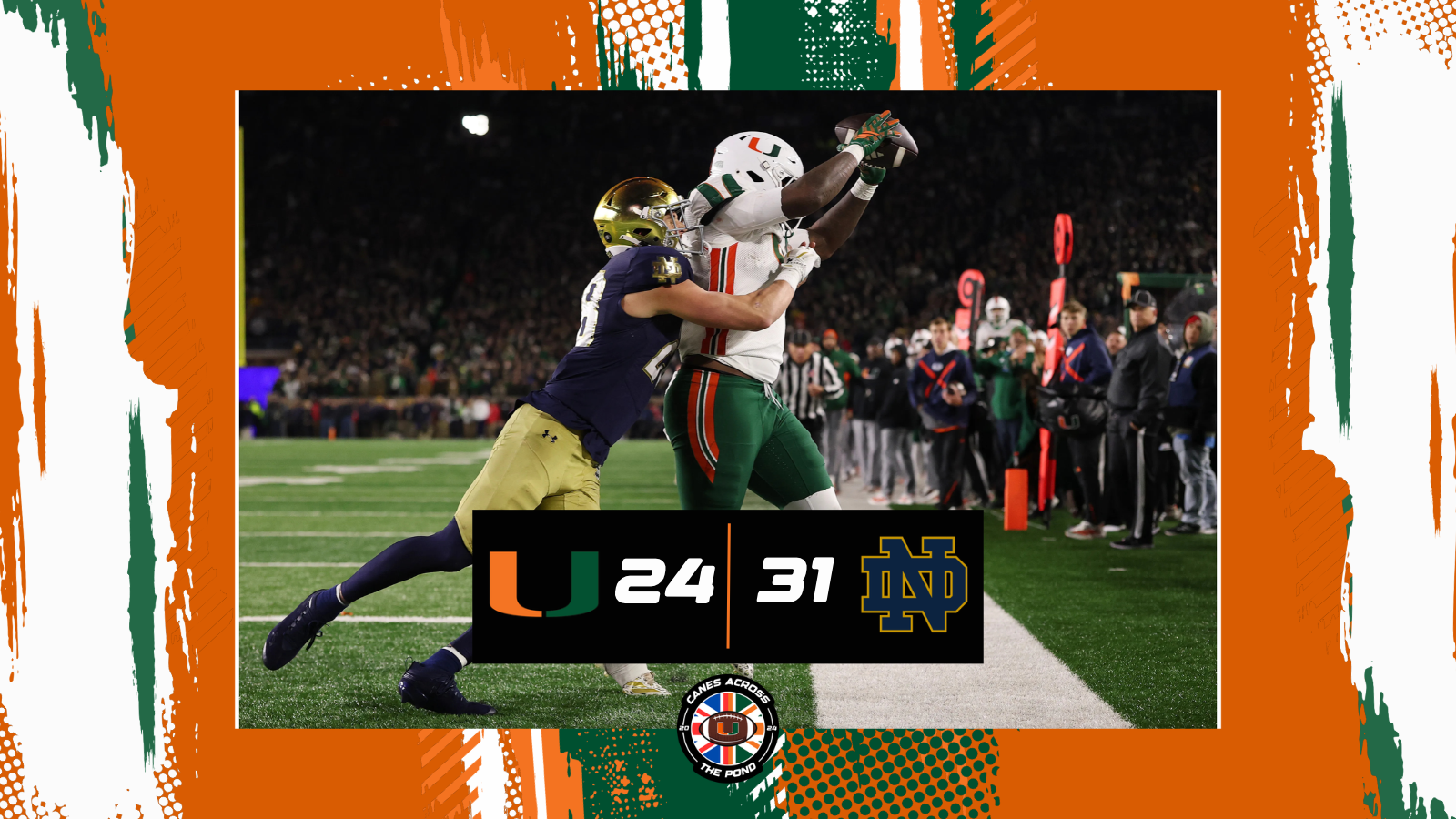
MATCH REPORT · FINAL
MIAMI
24
Final
NOTRE DAME
31
7 NOVEMBER 2026 · SOUTH BEND, INDIANA
THE BIG TAKEAWAY
Miami’s unbeaten run ended in South Bend after a 24-3 deficit proved too much, despite a second-half fightback that pulled the Hurricanes back within a touchdown of Notre Dame.
The unbeaten season is over. Miami’s second-half fightback nearly produced a remarkable comeback in South Bend, but a disastrous first half and a controversial late incompletion left the Hurricanes facing their first defeat of 2026.
There are few things more frustrating in sport than watching your team lose when you know they’re capable of playing so much better.
That’s exactly how I felt watching Miami fall 31-24 to Notre Dame in the early hours of Sunday morning.
I’ve watched the Hurricanes produce some brilliant performances this season. We’ve seen the offence tear teams apart, Darian Mensah establish himself as one of the country’s best quarterbacks and a Miami team that, for much of the year, looked capable of beating anybody.
But for the first half in South Bend, I barely recognised them.
Miami looked hesitant, struggled to move the football and allowed Notre Dame to take control of a game I genuinely believed we could win.
The frustrating part? Once Miami finally started playing in the second half, they showed exactly why I’d been so confident.
By the final whistle, I was gutted.
Not because we’d lost to a poor team. Notre Dame are an excellent football programme, and there was a reason the bookmakers made them favourites despite Miami arriving as the nation’s No. 1 team.
I was gutted because I believe we were capable of going into their own backyard and winning.
And for large parts of the game, we simply didn’t give ourselves that chance.
Another Late Night in Yorkshire, and a Frustrating First Half
Following the Hurricanes from the UK means accepting that some of the biggest games of the season will finish when most sensible people are fast asleep.
Saturday was another of those occasions.
I settled in to watch the game through Notre Dame’s Fighting Irish TV stream, which was providing coverage for international viewers.
Now, I don’t know whether it was just me being particularly sensitive as a Miami supporter, but the commentary was driving me mad.
It felt so heavily in Notre Dame’s favour that I genuinely wondered whether I was listening to a dedicated Fighting Irish commentary team rather than the regular American television broadcast.
It turned out to be the same coverage viewers in the United States were watching.
That didn’t make it any less irritating.
Unfortunately, the commentary was soon the least of my concerns.
Notre Dame started comfortably, moving the ball on their opening possession before Spencer Porath kicked a 44-yard field goal.
Miami’s opening offensive possessions offered very little in response, and it wasn’t long before CJ Carr connected with Jordan Faison for a 27-yard touchdown to make it 10-0.
Coming into the game, the big question had been how Miami would cope without Malachi Toney following his ankle injury and subsequent surgery.
We knew losing a player of Toney’s quality would make life more difficult against one of the country’s best defences.
What I hadn’t expected was for Miami to look so reluctant to attack.
Watching the first half, it almost felt as though we were afraid to throw the football without Mali on the field.
Whether that was the game plan, Notre Dame’s defensive approach or simply a lack of confidence, I don’t know.
But it wasn’t the Miami offence we’ve become accustomed to watching.
The Goal-Line Opportunity That Still Frustrates Me
If there’s one moment from the first half that sums up my frustration, it’s the possession where Miami had first-and-goal from the Notre Dame one-yard line.
We’d finally put together a decent drive. Mensah had connected with Cooper Barkate and Vandrevius Jacobs, and Notre Dame penalties had helped us get into an excellent position to score.
One yard away.
Surely this was the opportunity to get ourselves back into the game?
Instead, Miami couldn’t punch the ball into the end zone.
Mark Fletcher Jr. was stopped on first down, and two further rushing attempts failed to produce the touchdown.
Eventually, Jake Weinberg came on to kick a 19-yard field goal.
Three points.
I know Notre Dame have an outstanding defensive front, but I’d have liked to see Fletcher given another opportunity to power straight through the middle.
He’s been such an important part of this offence, and that felt like a moment to trust your running back to get the hard yards.
Instead, Miami had to settle for three when seven were desperately needed.
Those four missing points would become increasingly significant as the game developed.
And while Miami were struggling to finish drives, Notre Dame were doing the opposite.
Carr found Micah Gilbert for an 18-yard touchdown just before half-time, sending the Fighting Irish into the break leading 17-3.
Three points from Miami’s offence in an entire half of football.
That simply isn’t good enough for a team with national championship ambitions.
At 24-3, I Nearly Turned the Television Off
If the first half was difficult to watch, the beginning of the third quarter was even worse.
Miami received the ball after half-time but couldn’t get anything going.
Then Jordan Faison returned a Dylan Joyce punt 56 yards, giving Notre Dame excellent field position.
Two plays later, Carr found Gilbert again for a touchdown.
24-3.
Twenty-one points behind, in one of college football’s most intimidating stadiums, against a defence that had spent the first half making our offence look completely ordinary.
I’ll admit it.
At that point, I was ready to switch the television off and go to bed.
It was getting late, the game was slipping away and I couldn’t see where the comeback was going to come from.
But then I had a thought.
I’ve supported this team through plenty of difficult moments. Was I really going to abandon them just because they were having a bad night?
No.
If the players were going to have to see this game through, the least I could do was stay awake and support them.
And I’m glad I did.
Because what happened next was the Miami Hurricanes team I’d been expecting to see from the opening kick-off.
Miami Finally Come Alive
At 24-3, the game was threatening to become a blowout.
Instead, Miami started fighting back.
Mensah began looking more comfortable, the offence found some rhythm and, crucially, players started making the sort of plays we’d been missing during the first half.
Elija Lofton was central to that turnaround.
The tight end found space, made important catches and eventually got Miami into the end zone with a 12-yard touchdown reception.
24-10.
Not exactly a comfortable position, but suddenly there was a little hope.
After the defence forced Notre Dame into a quick three-and-out, Miami had an opportunity to build on that momentum.
And this time, they took it.
On fourth-and-one, Mensah found Lofton for a crucial 31-yard gain that kept the drive alive.
Shortly afterwards, Cooper Barkate caught a 12-yard touchdown pass.
24-17.
Now we had a game.
In the space of two possessions, Miami had transformed what looked like a certain defeat into something that suddenly felt very interesting.
And from my sofa, I was beginning to believe again.
What impressed me most was the way Mensah, Lofton and Barkate started taking responsibility.
Without Toney, we needed other players to step forward.
They did exactly that.
Lofton finished with seven receptions for 113 yards and a touchdown, while Barkate caught two touchdown passes of his own.
These are talented football players. They don’t suddenly become incapable of making plays because Malachi Toney isn’t on the field.
If anything, the second half should serve as a reminder to Shannon Dawson that Miami have several dangerous offensive weapons available.
We need to keep targeting them.
Unfortunately, just as the momentum appeared to have shifted completely, Miami gave Notre Dame another opportunity.
Mensah was intercepted by Luke Talich late in the third quarter, and the Fighting Irish capitalised.
A huge fourth-down conversion to Nolan James Jr. helped move Notre Dame deep into Miami territory before James finished the drive with a one-yard touchdown run.
31-17.
Having worked so hard to get back within seven, Miami were suddenly two touchdowns behind again.
But this time, they didn’t disappear.
Mensah continued attacking, Barkate produced another important gain and Miami drove downfield before the pair combined for a one-yard touchdown.
31-24.
With 9:53 remaining, the Hurricanes were right back in it.
Whatever criticisms I have of the team’s performance, I can’t question the fight they showed to get themselves into that position.
They could have accepted defeat at 24-3.
They didn’t.
And that deserves recognition.
The Elija Lofton Catch: A Touchdown or an Incompletion?
Of course, we can’t discuss this game without talking about the play everyone is arguing about.
With 3:36 remaining, Miami faced fourth-and-six from the Notre Dame 18-yard line.
Mensah escaped pressure and delivered a pass towards Lofton in the end zone.
Lofton got his hands on the football, appeared to establish control and landed with both feet in bounds.
Then Notre Dame defender Luke Talich knocked the ball loose.
The officials ruled the pass incomplete, and after reviewing the play, the decision stood.
Just like that, Miami’s best opportunity to tie the game had disappeared.
Now, I should make something clear.
I’ve never played a snap of American football in my life. I’m not going to sit here pretending to know the rulebook better than officials who have spent years studying it.
But watching that play, I thought it was a touchdown.
I still do.
To my eyes, Lofton had the football under control, got his feet down in bounds and only lost possession when Talich knocked it away as the play carried towards the boundary.
I understand that the college football rules require more than simply catching the ball and getting a foot down. A receiver must maintain control long enough to have the opportunity to perform an act common to the game.
That’s the part of the rule the officials believed Lofton hadn’t satisfied.
But here’s what I keep coming back to.
At what point does a receiver go from having possession to having completed the catch?
I’ve seen former players, journalists, commentators and supporters all offering different interpretations of what happened.
NBC rules analyst Terry McAulay supported the incompletion ruling, while Mario Cristobal made his disagreement clear after the game.
For me, that says something about how difficult the catch rule can be to interpret.
When people who understand football far better than I do are disagreeing over a decision, it’s hardly surprising ordinary supporters are left scratching their heads.
I’m not asking for the rules to be rewritten because Miami lost. I just think it’s reasonable to question why that wasn’t considered a completed catch.
Had the touchdown been awarded, Miami would have been an extra point away from tying the game.
It would have been an extraordinary comeback.
Miami did get one final opportunity after Notre Dame ran down the clock and punted.
With 57 seconds remaining, the Hurricanes took over at their own 13-yard line.
Mensah was sacked on the opening play but managed to keep the drive alive, eventually finding Vandrevius Jacobs for a 17-yard gain.
Unfortunately, time was almost gone.
A desperate final play ended with Notre Dame recovering a fumble, and that was that.
But I want to be careful here.
That decision is not the reason Miami lost this game.
We can’t spend an entire match underperforming and then leave our hopes in the hands of the officials.
The Lofton decision was controversial.
The first half was unacceptable.
And for me, the second of those two things was the bigger problem.
The Defensive Problems Aren’t Going Away
Although much of the attention will understandably focus on Miami’s offensive struggles and that late decision, the defence deserves some scrutiny too.
One of my biggest concerns coming into this game was the secondary.
After watching North Carolina repeatedly find success through the air last weekend, I was hoping for a much stronger response against Notre Dame.
Unfortunately, some of those concerns remain.
Carr finished with 319 passing yards and three touchdowns, while Gilbert caught nine passes for 98 yards and two scores.
Notre Dame deserve credit for their execution. They took their opportunities, protected their quarterback and found ways to exploit Miami’s defensive weaknesses.
But some of the issues we’ve been seeing are becoming far too familiar.
Big passing plays.
Receivers finding space.
And screen passes.
Honestly, I don’t know what it is about screen passes, but Miami seem to have enormous difficulty defending them.
Notre Dame used short throws and screens effectively throughout the game, often allowing players to turn relatively simple completions into useful gains.
That’s something Corey Hetherman and his defensive staff need to address.
The lack of pressure on Carr was another major concern.
Miami finished without recording a single sack or forcing a turnover.
Against an opponent of Notre Dame’s quality, that’s a difficult combination to overcome.
The Hurricanes needed their defence to create momentum, especially when the offence was struggling in the first half. Instead, Carr was regularly able to operate with enough time to find his receivers.
It’s worth acknowledging that Notre Dame were also dealing with injuries, particularly on defence.
Both teams had challenges to overcome.
We can’t simply point to Malachi Toney’s absence and use that as an explanation for everything that went wrong.
I genuinely believe Miami have the personnel to compete with the best teams in college football, but the schemes need to put those players in positions where they can succeed.
We need better coverage in the secondary, more effective answers against screens and greater pressure on opposing quarterbacks.
Because if we continue giving teams those opportunities, they’re going to keep taking advantage of them.
PLAYER OF THE GAME
Canes Across the Pond Player of the Game: Elija Lofton
On a difficult night, Elija Lofton gave Miami’s offence a route back into the game.
He finished with seven receptions for 113 yards and a touchdown, while his 31-yard fourth-down catch helped keep the comeback alive.
His disputed end-zone catch could have tied the game, but even without that play, Lofton was Miami’s most consistent attacking threat.
Player of the Game: Elija Lofton.
LOFTON
113 yards
7 catches · 1 TD
BARKATE
2 touchdowns
Both scores in the comeback
DEFENCE
0 sacks
0 takeaways
Could This Be Miami’s SMU Moment?
Despite everything I’ve said about the performance, there are positives to take from the defeat.
And I’m hoping this could become something of an SMU moment for the Hurricanes.
Last November, Miami lost 26-20 in overtime at SMU. It was a frustrating defeat that left plenty of questions about the team’s playoff chances and whether they could respond when the pressure was on.
What followed was a strong finish to the season and a run all the way to the National Championship Game.
I’m hoping this defeat can have a similar effect.
A result that forces the team to look at itself, address the problems and respond by playing its best football when it matters most.
At 24-3, things were starting to look embarrassing. Miami could easily have allowed the game to get away from them completely.
Instead, they fought back, rediscovered their attacking rhythm and very nearly produced one of the most memorable comebacks in recent programme history.
That second-half performance showed what this team is capable of.
Now I want to see it for four quarters.
We’ve got fantastic offensive weapons, even without Toney.
Mensah can make the throws. Barkate and Lofton have shown they’re capable of making big plays, while Fletcher and Javian Mallory offer different threats in the running game.
So let’s use them.
Let’s stop playing cautiously and start taking games to opponents.
For the final few weeks of the regular season, I want Miami to come out attacking, putting teams under pressure and looking to put games away rather than allowing opponents to hang around.
We’ve seen this offence score points in bunches. There’s no reason to lose faith in that ability because of one defeat.
But the coaching staff have to find ways to make it work consistently.
The second-half comeback should provide encouragement.
It shouldn’t be used to excuse the first-half performance.
WHAT IT MEANS
What Does This Mean for Miami’s Playoff Ambitions?
Well, that’s my 12-0 regular-season prediction officially gone.
I backed Miami to run the table before the season, and for eight games it was looking pretty good.
Unfortunately, Notre Dame had other ideas.
The Hurricanes are now 8-1, and the unbeaten season is over.
But our College Football Playoff ambitions certainly aren’t.
Miami still have Duke, Virginia Tech and Boston College remaining on the regular-season schedule.
All three games are at Hard Rock Stadium, and the Hurricanes remain in the ACC Championship race.
The task now is straightforward, even if achieving it won’t necessarily be easy.
Win out.
Get back to playing the football that took this team to No. 1 in the country.
And give ourselves the strongest possible opportunity to reach the postseason.
I’m still confident Miami can make the College Football Playoff, but this defeat has reduced the margin for error.
For me, it’s not a question of whether the players are good enough.
They are.
It’s about finding the right approach on both sides of the football and producing it consistently.
We need to start games faster, trust our offensive weapons and find a defensive system that stops giving opponents so many opportunities.
The ACC Championship is still there to fight for.
The playoff is still there to fight for.
And if Miami respond in the right way, this defeat doesn’t have to define the season.
The Last Word from Across the Pond
When the final whistle went, I was gutted.
I’d spent the build-up believing Miami had a genuine opportunity to go into South Bend and beat Notre Dame.
Yes, the bookmakers had us as underdogs. Yes, Notre Dame have one of the best defences in the country. And losing Malachi Toney just days before kick-off was a huge setback.
But I still believed.
That’s what made the defeat so frustrating. We didn’t simply lose to an excellent Notre Dame team. We contributed to our own downfall.
At 24-3, I was ready to turn the television off and go to bed.
I’m glad I didn’t.
Because the second half reminded me why I’ve got so much faith in this group.
Mensah started making plays, Lofton and Barkate stepped forward and suddenly the Hurricanes were competing rather than simply trying to survive.
For a while, I genuinely thought we might pull it off.
And when Lofton appeared to catch that football in the end zone, I thought we were about to witness something special.
Unfortunately, it wasn’t to be.
We’ll probably be debating that decision for a long time, but the bigger lesson is that Miami shouldn’t have needed a controversial fourth-down call to rescue the game.
We can’t keep giving good teams a head start or waiting until we’re in trouble before finding our attacking rhythm.
The unbeaten record is gone.
My 12-0 prediction is gone.
But my belief in this team isn’t.
I hope we look back at this result at the end of the season as the moment Miami realised that simply having the talent isn’t enough.
It’s time to use it.
Three regular-season games remain, and there’s still an opportunity to achieve something special.
So let’s stop worrying about what we’ve lost and start focusing on what’s still possible.
Go Canes.
NEXT UP
Miami vs Duke
BACK TO HARD ROCK
Saturday 14 November · 12:00pm ET / 5:00pm GMT · Hard Rock Stadium, Miami Gardens, FL
