
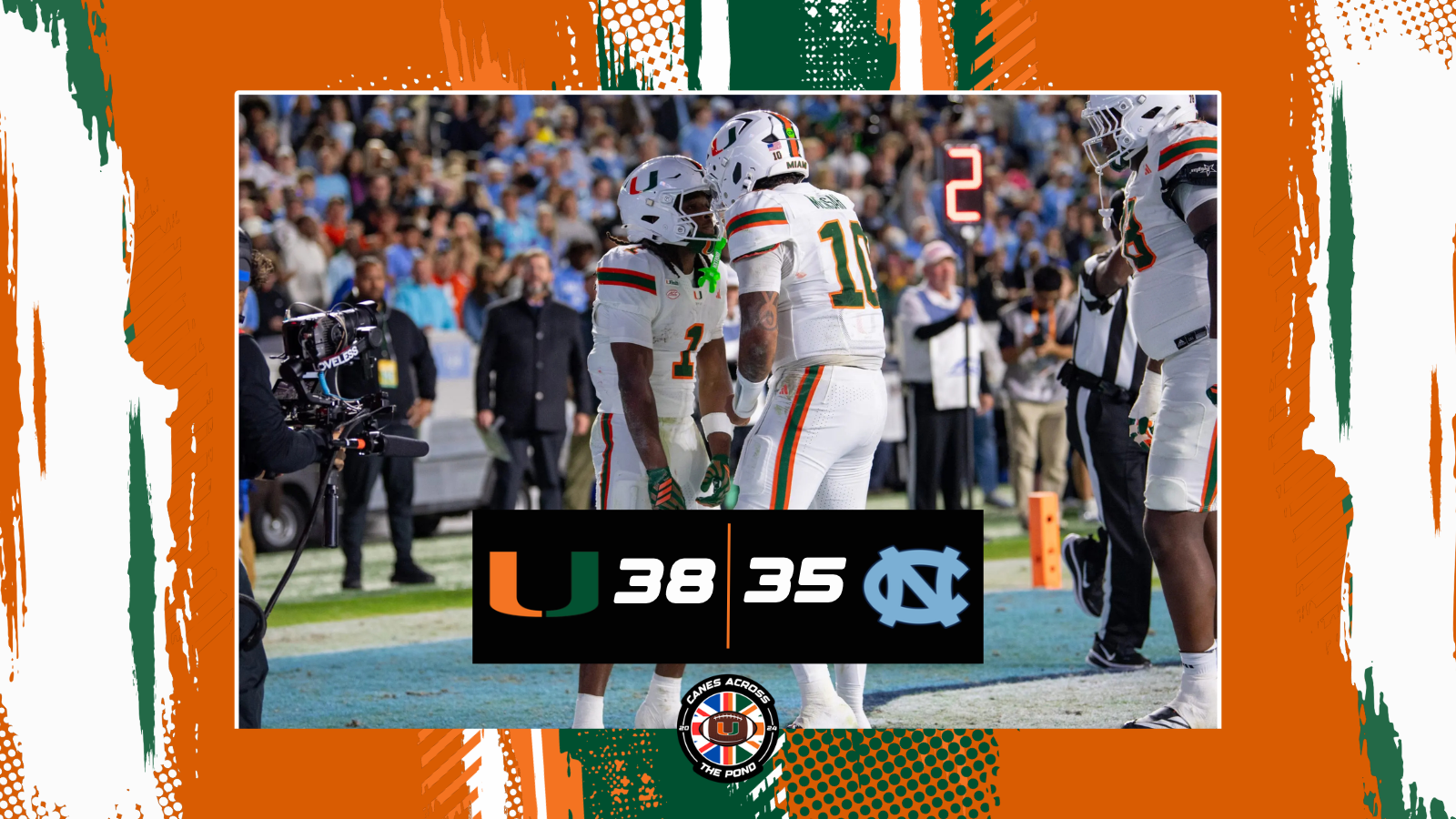
MATCH REPORT · FINAL
MIAMI
38
Final
NORTH CAROLINA
35
31 OCTOBER 2026 · CHAPEL HILL, NORTH CAROLINA
THE BIG TAKEAWAY
No. 1 Miami survived a Halloween scare in Chapel Hill, beating North Carolina 38-35 to move to 8-0 and finally end the Tar Heels’ five-game winning streak in the series.
Miami are 8-0, still unbeaten and have finally ended that ridiculous five-game losing streak against North Carolina. The No. 1 Hurricanes survived a Halloween scare in Chapel Hill, beating the Tar Heels 38-35 in a game that was far more uncomfortable than I’d hoped.
And despite the victory, I spent much of Saturday night wondering whether Miami were about to throw away their perfect season.
After the chaos of trying to follow last week’s Pittsburgh game between a Chinese takeaway, a car journey and a birthday party, I was back to my usual match-day setup. DAZN had the game live in the UK, so I settled down in the front room with the television showing the action and my laptop, phone and iPad keeping me up to date with statistics, reactions and everything else going on around college football.
For once, I managed to watch every minute live without family commitments getting in the way. Unfortunately, having four screens available doesn’t make it any less frustrating when your defence can’t seem to get off the field.
North Carolina deserve enormous credit for the way they approached this game. With Bill Belichick and offensive coordinator Bobby Petrino on the coaching staff, you know you’re dealing with people who understand football at the highest level. They had a plan, they executed it brilliantly and quarterback Billy Edwards Jr. produced an outstanding performance.
But as impressive as UNC were, I still felt Miami let themselves down defensively.
The offence did almost everything you could ask of it, yet the Hurricanes needed a crucial fourth-quarter turnover from Marquise Lightfoot and a chaotic finish involving three onside-kick attempts to escape with the win.
It’s not how I imagined this game going, but the most important thing is that Miami found a way.
A Promising Start That Quickly Became Frustrating
Miami began the game exactly how you’d expect the No. 1 team in the country to start.
Darian Mensah led the Hurricanes on an impressive 13-play, 74-yard opening drive, showing patience and using his legs twice to convert third downs. The possession ended with a beautiful two-yard touchdown pass to Malachi Toney, who made an outstanding catch in the end zone to give Miami an early 7-0 advantage.
The defence then managed to stop North Carolina on their opening possession, and for a brief moment everything seemed to be going to plan.
That feeling didn’t last particularly long.
On their next possession, the Tar Heels marched 84 yards in 11 plays, with Edwards finding tight end Jelani Thurman for an eight-yard touchdown early in the second quarter.
Miami responded through Mark Fletcher Jr., who took a short pass from Mensah and turned it into a 31-yard touchdown. It was an excellent piece of execution, with Fletcher showing why he remains such a valuable part of this offence.
But again, UNC had an answer.
Edwards led another long drive, this time covering 75 yards in 12 plays, before connecting with Thurman for another eight-yard touchdown to level the game at 14-14.
At this point, my frustration with Miami’s defence was starting to build. Apart from that opening UNC possession, the Hurricanes simply weren’t finding ways to stop the Tar Heels. Edwards looked comfortable, his receivers were finding space and North Carolina were sustaining drives that seemed to go on forever.
Miami managed to regain the lead just before half-time, with a 40-yard connection between Mensah and Cooper Barkate helping set up Jake Weinberg’s 25-yard field goal.
A 17-14 lead at the break wasn’t a disaster by any means, but it certainly wasn’t the comfortable evening I’d been hoping for.
North Carolina Refused to Go Away
If the first half was frustrating, the second half took things to another level.
North Carolina received the opening kick-off and immediately went on another long touchdown drive, with Edwards finding Jordan Shipp from 16 yards to give the Tar Heels a 21-17 lead.
Miami responded through Fletcher, whose two-yard rushing touchdown restored a narrow 24-21 advantage after an eight-play, 80-yard drive.
The problem was that every time the Hurricanes’ offence did its job, North Carolina seemed capable of doing exactly the same.
The Tar Heels’ next touchdown drive was particularly painful to watch. They used 16 plays to travel 75 yards, consuming more than eight minutes of the clock before Demon June scored from a yard out early in the fourth quarter.
That put UNC back ahead 28-24.
Credit has to go to Edwards and Petrino for the way they attacked Miami’s defence. They understood what was available, took advantage of favourable matchups and kept finding ways to move the chains.
But I also think it’s fair to question Miami’s execution.
The Hurricanes came into the game with one of the best defences in college football, particularly against the run, yet they couldn’t consistently get off the field against a North Carolina offence that had struggled at times this season.
The Tar Heels converted eight of their 11 third downs and both of their fourth-down attempts. Edwards finished with 341 passing yards and four touchdowns, repeatedly finding receivers in space and keeping Miami under pressure.
It was the sort of defensive performance that becomes increasingly concerning when you’re thinking about national championship ambitions.
Miami were still competitive because their offence was performing so well, but at some point somebody on defence needed to make a play.
Thankfully, somebody eventually did.
Mark Fletcher Jr. Answers His Critics
Before getting to the play that changed the game, Mark Fletcher Jr. deserves some serious recognition.
There have been calls from sections of the fanbase for Fletcher to be moved down to RB2, with questions about whether Miami would benefit from changing the balance of its backfield.
Well, Fletcher certainly had something to say about that on Saturday.
He finished with three touchdowns, scoring once through the air and twice on the ground. His 31-yard receiving touchdown in the second quarter showed his versatility, while his two short rushing scores demonstrated why Miami continue to trust him in crucial situations.
The second rushing touchdown was particularly important.
Trailing 28-24 in the fourth quarter, Miami put together a nine-play, 75-yard drive that ended with Fletcher powering into the end zone from two yards out on fourth-and-one.
That was a significant moment. Rather than settling for a field goal or getting caught up in the pressure of the situation, Mario Cristobal trusted his offensive line and his running back to get the job done.
They delivered, putting Miami back ahead 31-28 with 7:49 remaining.
Fletcher also wrote himself into the Hurricanes’ record books. His three touchdowns took him to 38 career touchdowns, making him Miami’s all-time leader in touchdowns scored. His 35th rushing touchdown also tied Stephen McGuire’s school record.
That’s quite an achievement for a player who has faced criticism from some supporters in recent weeks.
Fletcher’s value has never been about simply producing the biggest rushing numbers every Saturday. He gives Miami physicality, reliability and someone the coaching staff can trust when the game is on the line.
On Halloween night, he reminded everybody exactly why that matters.
Marquise Lightfoot Changes the Game
For all the attacking quality on display, the defining defensive moment arrived with just over five minutes remaining.
Miami were leading 31-28 after Fletcher’s touchdown, but given how North Carolina had moved the ball throughout the night, I wasn’t particularly confident that three-point advantage would survive another UNC possession.
Edwards had been outstanding, and the Hurricanes had struggled to generate the sort of pressure that might force him into a mistake.
Then Marquise Lightfoot stepped up.
Lightfoot got around the North Carolina protection and reached Edwards from behind, producing a crucial strip-sack that forced the quarterback to lose possession. Justin Scott reacted quickly to recover the football at the UNC 37-yard line, handing Miami an opportunity to finally create some separation.
It was enormous.
Up until that point, I genuinely couldn’t see how Miami were going to stop North Carolina. The Tar Heels had moved the ball almost at will after their opening possession, and every scoring drive seemed to be followed by another long UNC response.
Lightfoot’s intervention completely changed the situation.
He finished with four tackles, two sacks and the forced fumble, but no statistic really captures how important that particular play felt.
Miami suddenly had the ball in excellent field position with a chance to build a two-score lead. The offence still needed to make the opportunity count, but Lightfoot had finally delivered the moment the defence desperately needed.
And there was another outstanding individual play still to come.
Lofton’s Leap and Toney’s Touchdown
The possession following Lightfoot’s strip-sack could easily have been remembered simply as the drive where Miami extended its lead.
But Elija Lofton made sure there was something else worth talking about.
Facing a crucial situation, Lofton caught the football and produced a brilliant leap over a would-be tackler to keep the drive moving. It was one of those moments where an individual piece of athleticism makes the difference between a drive stalling and an offence continuing towards the end zone.
It might not receive the same attention as a touchdown or a forced turnover, but I thought it was an outstanding play.
Six plays after Scott’s recovery, Mensah found Toney for a nine-yard touchdown that extended Miami’s lead to 38-28 with 2:33 remaining.
Toney finished with seven receptions for 75 yards and two touchdowns, and although it wasn’t another record-breaking performance like the one against Pittsburgh, he continued to show why he’s become such an important part of the Hurricanes’ offence.
He’s Mr Reliable.
Whenever Mensah needs somebody to make a play, Toney seems to find a way to deliver.
At 38-28, with only a couple of minutes remaining, you’d like to think Miami had finally done enough.
Apparently, that would have been far too straightforward.
The Finish Was Far Too Close for Comfort
North Carolina responded to Miami’s ten-point lead with another impressive drive.
Edwards moved the Tar Heels 75 yards in just five plays, eventually finding Trech Kekahuna for a 15-yard touchdown to reduce Miami’s advantage to 38-35.
Just like that, it was a three-point game again.
I genuinely thought we’d blown it.
After everything Miami’s offence had done, after Fletcher’s three touchdowns and Lightfoot finally producing the defensive play we needed, the Hurricanes were still in danger of letting North Carolina back into the game.
And then came the onside kicks.
North Carolina recovered their first attempt, only for an offside penalty to wipe it out. They tried again, recovered the football for a second time, and once again saw the play overturned, this time because of an illegal block.
By this stage, I was wondering whether there was any possible way for Miami to make the ending more stressful.
Thankfully, the third attempt finally fell Miami’s way, allowing the Hurricanes to retain possession and see out the remaining time.
The relief was enormous.
It wasn’t pretty, and there are plenty of questions to ask about how Miami allowed the game to reach that point, but none of those questions change the result.
Miami had survived.
And that five-game losing streak against North Carolina was finally over.
The Defence Has Some Questions to Answer
It would be easy to focus entirely on the comeback and the fact Miami found a way to win, but I don’t think we should ignore what happened defensively.
North Carolina finished with 407 total yards, including 341 through the air, while scoring five touchdowns against a Miami side that had entered the weekend with national championship ambitions and one of the most highly regarded defensive fronts in the country.
To Miami’s credit, the run defence largely did its job. UNC managed only 66 rushing yards, a reminder that the Hurricanes remain extremely difficult to move against on the ground.
The problems came when Edwards was given time to operate.
Whether it was missed tackles, receivers finding space or the inability to force difficult third-down situations, North Carolina repeatedly found ways to extend drives. The Tar Heels recorded 27 first downs and made Miami’s defence spend far too much time on the field.
I don’t want to take anything away from Edwards, who produced one of the best performances of his career. His four touchdown passes were a career high, and he was excellent at identifying where Miami were vulnerable.
But that’s precisely why the performance concerns me.
When a talented, well-coached opponent starts exploiting weaknesses, Miami need to be able to adjust and respond. The defensive front eventually produced the decisive turnover, but it shouldn’t require a moment of individual brilliance every time the team needs a stop.
The Hurricanes have already demonstrated that they can beat opponents in different ways. Now they need to show they can make adjustments defensively when an offence starts finding success.
That’s going to matter enormously over the coming weeks.
PLAYER OF THE GAME
Canes Across the Pond Player of the Game: Darian Mensah
There are several players who deserve consideration this week, but I’m giving my Canes Across the Pond Player of the Game award to Darian Mensah.
Mark Fletcher Jr. scored three touchdowns and made Miami history. Marquise Lightfoot produced the game’s most important defensive play, while Malachi Toney once again delivered when the Hurricanes needed him.
However, Mensah was the player who kept Miami’s offence moving throughout the night.
He completed 22 of 29 passes for 274 yards and three touchdowns, without throwing an interception. He also added 36 rushing yards, demonstrating a willingness to use his legs when the passing options weren’t immediately available.
That last point stood out to me.
On Miami’s opening drive, Mensah used his mobility twice to keep the chains moving on third down. Those were important plays, and they set the tone for a performance where he consistently made good decisions under pressure.
Mensah didn’t need to throw for 400 yards or produce another spectacular statistical performance. He needed to manage the offence, recognise what the defence was giving him and keep Miami in a position to win.
That’s exactly what he did.
Even when North Carolina were matching Miami score for score, Mensah remained composed. The Hurricanes didn’t panic, and their quarterback continued to move the ball effectively, whether that meant finding Toney, involving Fletcher or picking up yards himself.
It’s becoming increasingly difficult to find new ways of praising this Miami offence, but Mensah deserves enormous credit for how efficiently he continues to operate it.
He might not have produced the most eye-catching individual performance on Saturday, but for me he was the biggest reason Miami remained in control of its own destiny.
Player of the Game: Darian Mensah.
MENSAH
274 yards
22-of-29 · 3 TD · 0 INT
FLETCHER
3 touchdowns
38 career TD · Miami record
LIGHTFOOT
2 sacks
4 tackles · 1 forced fumble
WHAT IT MEANS
Eight Wins, No Defeats and a Streak Finally Ended
Now that the nerves have settled, it’s worth remembering just how significant this result actually is.
Miami are 8-0 overall and 6-0 in the ACC, sitting at the top of the conference standings and remaining one of only three unbeaten teams in the entire FBS.
Utah and UCLA are the other two.
That’s it.
Three unbeaten teams across college football, and Miami are one of them.
We also finally have a victory over North Carolina, ending a five-game losing streak in the series and securing the Hurricanes’ first win in Chapel Hill since 2017.
For all my frustrations with the defensive performance, those achievements shouldn’t be overlooked.
I also have to acknowledge that my prediction was half right.
I went with a 38-17 Miami victory in the match preview, and the Hurricanes did their bit by scoring exactly 38 points.
Unfortunately, North Carolina didn’t appear particularly interested in sticking to my prediction and decided to score another 18.
I’ll take partial credit for that one.
What matters more is how Miami responded when things weren’t going according to plan.
Twice in the second half, the Hurricanes found themselves trailing, and twice they responded with touchdown drives to restore their advantage. When the defence finally produced the turnover they needed, the offence immediately made it count.
It wasn’t the controlled, comfortable performance I had hoped for, but it was another example of this team finding a way to win.
And that brings us to the bigger picture.
Notre Dame Awaits
Next Saturday, Miami travel to South Bend for one of the biggest games of the college football season.
Notre Dame entered this weekend ranked No. 5 and strengthened their position with a 35-13 victory over Navy. The Fighting Irish will present another enormous challenge, particularly with the game taking place on their home field.
I expect it to be a battle right until the end.
There will be plenty of discussion over the coming days about how Miami’s defence performed against North Carolina and whether the same problems could emerge against Notre Dame. Those concerns are reasonable, and Corey Hetherman’s unit certainly have work to do.
But we also need to remember something.
Notre Dame have already been beaten this season.
Miami haven’t.
That doesn’t mean the Hurricanes can simply turn up and expect to win, but it should give them confidence. This is a team with an outstanding offence, a talented defensive front and a growing belief that they can find solutions when games become difficult.
I don’t think Miami need to reinvent anything before next weekend. They need to clean up the mistakes, execute their assignments and play the football that has taken them to eight consecutive victories.
Do that, and they’ll give themselves every chance of winning in South Bend.
The Last Word from Across the Pond
When that final onside kick was safely recovered and Miami could finally see out the game, my overriding feeling was relief.
Relief that we hadn’t thrown away the unbeaten record. Relief that North Carolina hadn’t managed to beat us for a sixth consecutive time. And relief that, despite some pretty serious defensive frustrations, the Hurricanes had found a way to win.
Mario Cristobal regularly talks about the importance of going 1-0 every week. It doesn’t matter what happened last Saturday or what might happen next weekend. The responsibility is to prepare properly, execute and find a way to win the game in front of you.
That’s exactly what Miami have done again.
Billy Edwards Jr. produced one of the best performances of his career, throwing for 341 yards and four touchdowns against a defence that had been among the country’s strongest coming into the weekend.
And it still wasn’t enough to beat Miami.
Sometimes I think we get so caught up in rankings, statistics and expectations that we forget how difficult it is to keep winning every single week. College football is full of good teams capable of producing outstanding performances, particularly when the No. 1 team in the country comes to town.
Championship teams find ways to win, even when things get ugly.
That doesn’t mean Miami should ignore the problems from Saturday. The defence needs to improve, particularly with Notre Dame waiting next weekend, and I’m sure Cristobal and his coaching staff will be spending plenty of time working through what went wrong.
But we shouldn’t lose sight of what went right either.
Mensah kept the offence moving. Fletcher responded to criticism with three touchdowns and a place in the record books. Toney continued to deliver, Lofton produced a brilliant individual play and Lightfoot came up with the turnover that ultimately decided the game.
Most importantly, the Hurricanes left Chapel Hill unbeaten.
Eight games. Eight wins.
Only three unbeaten teams remain in college football, and Miami are one of them.
Now let’s get ready for Notre Dame.
Go Canes.
NEXT UP
Miami at Notre Dame
SOUTH BEND SHOWDOWN
Saturday 7 November · 7:30pm ET / Sunday 8 November, 12:30am GMT · Notre Dame Stadium, South Bend, IN
