
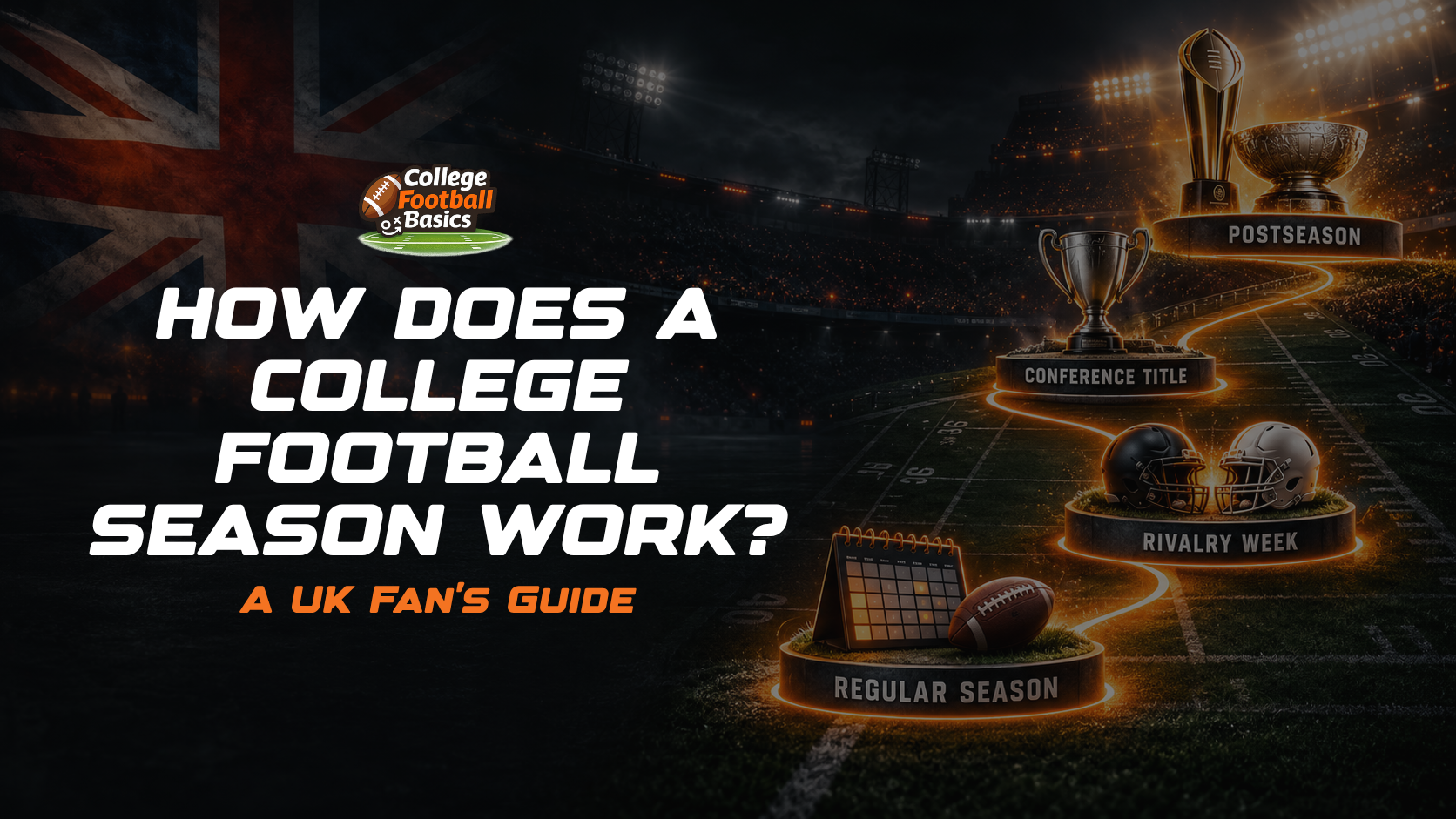
If you are new to college football, one of the first things you will notice is just how much seems to happen in a relatively short space of time.
Teams spend months preparing, the regular season flies by, rivalry games arrive, conference championships are played and suddenly everyone is talking about bowls and the College Football Playoff.
So how does it all fit together?
Here is the simple version.
When Does the College Football Season Start?
The college football season usually gets underway in late August, with the majority of teams beginning their schedules around the end of August or start of September.
From there, most teams play around once a week through the autumn.
Saturday is the traditional home of college football, although games can also take place on Thursdays, Fridays and occasionally other days of the week.
For UK fans, that means Saturdays can stretch from early evening right through to the early hours of Sunday morning.
How Many Games Does Each Team Play?
Most major college football teams play a 12-game regular season.
That schedule will usually be a mixture of:
- Games against teams from their own conference
- Non-conference games against teams from elsewhere
- Traditional rivalry games
- Occasionally a game against a lower-level programme
The exact balance depends on the conference and the individual school.
Unlike many sports, every team does not play every other team.
That is one reason why college football schedules, rankings and strength of opposition matter so much.
What Are Conference Games?
Most college football teams belong to a conference.
Miami, for example, plays in the Atlantic Coast Conference, better known as the ACC.
During the season, teams play several games against other members of their conference.
Those results help determine who reaches the conference championship game.
Conferences are a huge part of college football, so we have a separate College Football Basics guide explaining exactly how they work.
What Happens at the End of the Regular Season?
The final few weeks are where things really start to heat up.
Late November traditionally brings some of the biggest rivalry games of the season.
You might hear this period referred to as Rivalry Week.
For teams chasing championships, these games can decide conference positions, rankings and potentially College Football Playoff hopes.
Once the regular season ends, the major conferences hold their conference championship games.
These usually feature the top teams from that conference competing for the conference title.
Winning your conference can also be hugely important when the College Football Playoff field is selected.
What Is the College Football Playoff?
The College Football Playoff, usually shortened to the CFP, decides the national champion at the highest level of college football.
The current system features 12 teams.
Some teams qualify automatically through the conference system, while others are selected based on the final College Football Playoff rankings.
The highest seeds receive first-round byes, while the other teams begin in the opening round.
The winners continue through the quarter-finals and semi-finals before two teams meet in the National Championship Game.
It sounds complicated at first, but once you have watched one season it becomes much easier to follow.
We will cover the full system separately in our College Football Playoff guide.
And What Are Bowl Games?
Not every successful team reaches the College Football Playoff.
College football also has a large collection of postseason games known as bowl games.
Teams that have had good enough seasons can be invited to play in one.
Some bowls have decades of history behind them. Others are much newer and occasionally much stranger.
Yes, this is the sport where we have previously had to explain the Pop-Tarts Bowl.
Bowl season runs through December and into January and has become a tradition in its own right.
So What Does a Full Season Look Like?
The easiest way to remember it is:
- Late August/September: The season begins.
- September-November: Regular-season games.
- Late November: Rivalry games and the end of the regular season.
- Early December: Conference championship games.
- December-January: Bowl games and the College Football Playoff.
- January: The National Championship decides the champion.
And then, after all that, college football fans immediately start talking about recruiting, transfers and next season.
There really is not much of an off switch.
The Last Word from Across the Pond
College football can look complicated when you first start following it because there are conferences, rankings, bowls and playoffs all happening around the same season.
But the basic structure is actually pretty straightforward.
Teams spend the autumn playing their regular-season schedule, the best compete for conference championships and the very best move on to compete for the national title.
Once you understand that basic journey from August to January, everything else starts to make much more sense.
And that is exactly what College Football Basics is here for.
