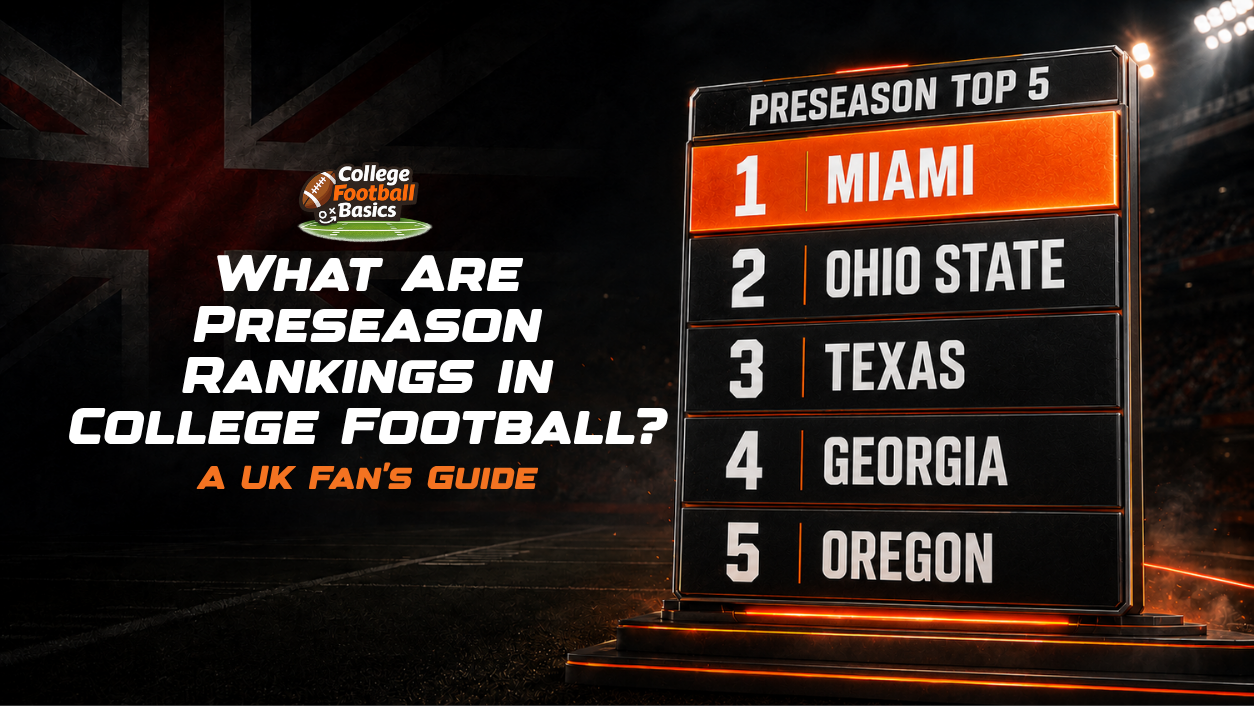
The college football season hasn’t even started.
Nobody has scored a touchdown. Nobody has won a game. Nobody has lost one.
And somehow, teams are already ranked.
Welcome to college football.
If you’re new to the sport, seeing something like No. 7 Miami vs Florida State can be slightly confusing. Who decided Miami were the seventh best team in the country when the season has barely begun?
That’s where preseason rankings come in.
They’re a huge part of the build-up to a new college football season, and while they don’t determine who eventually becomes National Champion, they give fans an early idea of which programmes are expected to be among the country’s best.
Here’s how it works.
What Are College Football Rankings?
College football has more than 130 teams competing at the FBS level, but they don’t all play each other.
That creates a problem.
How do you compare Miami with Ohio State, Georgia, Oregon or Texas if those teams might never meet during the regular season?
Rankings are one way of doing it.
Throughout the season, teams are placed in order from No. 1 downwards, with the Top 25 becoming the rankings you’ll see most often on television, social media and sports websites.
If Miami are ranked No. 7, it essentially means the voters currently consider the Hurricanes the seventh best team in the country.
The important word there is currently.
Rankings can change every week.
What Are Preseason Rankings?
Preseason rankings are exactly what they sound like.
They’re rankings published before the season begins.
Because nobody has played yet, voters have to make educated predictions about how good each team is likely to be.
They’ll consider things such as returning players, transfers, recruiting classes, coaching, quarterback situations and how the programme performed the previous season.
In other words, it’s an informed prediction.
And sometimes those predictions turn out to be very wrong.
That’s part of the fun.
What Is the AP Top 25?
The ranking you’ll probably hear mentioned most often early in the season is the Associated Press Top 25, usually shortened to the AP Top 25.
The AP poll has been part of college football since 1936, with its preseason poll first introduced in 1950.
A national panel of experienced sports writers and broadcasters votes on which teams they believe are the best in college football. More than 60 voters traditionally participate in the poll.
Each voter submits their own Top 25.
Points are then awarded depending on where teams appear on each ballot. A first-place vote earns 25 points, second place earns 24, third earns 23 and so on until the team ranked 25th receives one point.
All those votes are combined, and the team with the most points becomes No. 1.
Simple enough.
Until your team is ranked three places lower than you think they should be.
Then obviously the entire system is broken.
When Is the AP Poll Released?
The AP Top 25 is usually updated on Sunday afternoon in the United States after the weekend’s games, so UK fans generally see the new rankings on Sunday evening.
Teams move based on their results, the strength of their opponent and major upsets elsewhere in the country.
What About the Coaches Poll?
You’ll also hear about the Coaches Poll.
As the name suggests, this ranking is based on ballots submitted by a panel of FBS head coaches rather than journalists.
That’s why you might see Miami ranked No. 7 in one poll and No. 9 in another.
They’re different groups of people giving their opinions.
For new fans, the easiest thing to remember is that the AP Top 25 is generally the ranking you’ll see referenced most often during the early part of the season.
Why Does a Ranking Appear Next to a Team’s Name?
Once you understand the Top 25, something you’ll constantly see on television starts making sense.
Instead of Miami vs SMU, you might see No. 7 Miami vs No. 19 SMU.
Those numbers are their national rankings.
When two highly ranked teams meet, you’ll often hear it described as a Top 25 matchup. If both are ranked inside the top 10, you’ve got a Top 10 matchup.
Those games tend to attract more national attention because they could have a significant effect on the rankings and, later in the year, the College Football Playoff race.
What Happens When a Ranked Team Loses?
Usually, they fall.
How far depends on what happened.
Imagine No. 7 Miami loses by three points away against No. 4 Notre Dame. The Hurricanes might only drop a few positions because they’ve lost a close game against one of the country’s top ranked teams.
But imagine No. 7 Miami loses heavily at home against an unranked opponent. That’s a different story.
Miami could tumble down the rankings.
An unranked team that beats a highly ranked opponent, meanwhile, could suddenly enter the Top 25.
It’s why the rankings become one of the big talking points every Sunday during the season.
Can an Unranked Team Become No. 1?
Absolutely.
The preseason rankings aren’t permanent. They’re simply where voters think everyone stands before the games begin.
Once football starts, results take over.
A team ranked outside the Top 25 could keep winning, climb into the rankings and eventually become one of the country’s leading teams.
Equally, a preseason Top 10 team could lose several games and disappear from the rankings entirely.
That’s why being ranked highly in August is nice.
Being ranked highly in December is much more important.
Do Preseason Rankings Actually Matter?
Technically, they don’t decide anything.
Being No. 1 in August doesn’t give you extra points, an automatic conference championship or a guaranteed place in the College Football Playoff.
But that doesn’t mean they’re meaningless.
Preseason rankings shape expectations and influence the national conversation around a programme.
A highly ranked Miami team will receive more national attention, feature in bigger television windows and enter the season with expectations of competing for the ACC and the College Football Playoff.
There’s also a human element.
If voters begin the year believing one programme is elite, that perception can take time to change.
That’s why you’ll sometimes hear fans complain about preseason bias.
What Are College Football Playoff Rankings?
This is where new fans can easily get caught out.
The AP Top 25 and College Football Playoff rankings are not the same thing.
For the first part of the season, you’ll mainly see the AP rankings used when discussing where teams stand nationally.
Later in the year, the College Football Playoff Selection Committee releases its own rankings.
Those are the rankings that ultimately matter for deciding which teams make the College Football Playoff.
So Miami could theoretically be ranked No. 7 by the AP but No. 5 by the CFP committee.
Same football team. Different rankings.
College football likes to keep us on our toes.
Why Rankings Make Saturdays More Interesting
Once you start following the rankings, they add another layer to every Saturday.
Suppose Miami are ranked No. 8. The Hurricanes win comfortably, but No. 4 and No. 6 both lose.
Suddenly you’re looking ahead to the next rankings wondering how far Miami might climb.
It also means you’ll start caring about games involving teams you don’t support.
If Miami are competing for a College Football Playoff place and another Top 10 team is losing late in the fourth quarter, you’ll probably find yourself cheering for a university you’ve barely thought about before.
This is perfectly normal college football behaviour.
College Football Basics
AP Top 25
A weekly ranking of the top 25 college football teams, voted on by a national panel of sports writers and broadcasters.
Preseason Ranking
A ranking released before any regular-season games have been played.
Ranked Team
A team currently placed inside the Top 25.
Top 10 Matchup
A game featuring two teams ranked among the nation’s top 10.
Coaches Poll
A separate Top 25 ranking based on votes from a panel of college football coaches.
CFP Rankings
The rankings produced later in the season by the College Football Playoff Selection Committee.
The Last Word from Across the Pond
Preseason rankings are one of those college football traditions that seem slightly strange until you’ve followed the sport for a while.
We’re ranking teams before anyone has even kicked a football.
Of course we are.
But that’s part of the build-up.
For Miami fans, seeing The U sitting next to a little number when the season begins tells us what the wider college football world expects from the Hurricanes.
After that, the rankings have to be earned.
Win big games and Miami climbs. Lose and somebody else takes your place.
And by the time the College Football Playoff rankings arrive later in the season, nobody will care where you started in August.
It’s where you finish that matters.


Leave a Reply