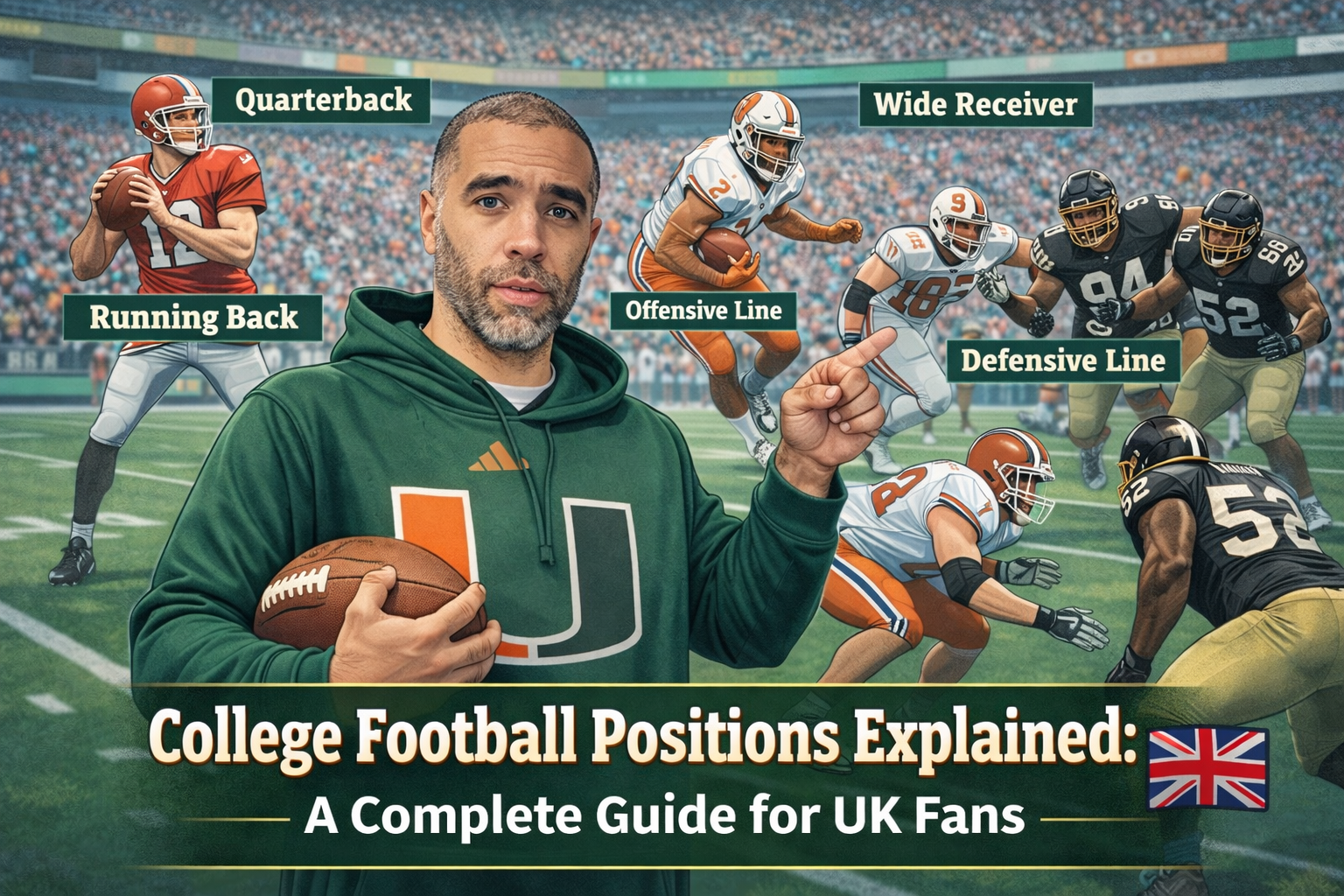
If you are new to American college football, one of the biggest hurdles is understanding the positions. There are 22 players on the field, constant substitutions, and highly specialised roles.
Unlike most UK sports, American football is built around precision and defined responsibility. Each player has a specific job on every single play. Once you understand who does what, the game slows down and becomes far easier to follow.
This guide explains every major college football position in simple terms, designed specifically for UK fans getting into the sport.
How Many Players Are on the Field in College Football?
At any one time:
- 11 players play offence
- 11 players play defence
- Separate specialist units handle kicking plays
Most players only play one side of the ball. Offensive and defensive units substitute frequently depending on situation, distance needed, and game plan.
If you have not yet read our breakdown of how the game flows, start with What Is a Down in American Football? A Simple Guide for UK Fans
Offensive Positions: Who Moves the Ball?
The offence is responsible for gaining yards and scoring points.

Quarterback (QB)
The quarterback is the most important player on the field.
Responsibilities:
- Receives the snap from the centre
- Reads the defence before and after the snap
- Decides whether to pass, hand off, or run
- Controls communication and tempo
College quarterbacks are often dual threats, capable of extending plays with their legs as well as their arm.
Why it matters: The entire offensive system revolves around the quarterback’s decision making.
Running Back (RB)
The running back lines up behind or next to the quarterback.
Responsibilities:
- Carries the ball on running plays
- Catches short passes
- Blocks defenders in passing situations
Many college teams rotate multiple running backs depending on situation.
Why it matters: A strong running game forces defences to commit extra players to the line, opening passing opportunities.

Wide Receiver (WR)
Wide receivers line up near the sidelines.
Responsibilities:
- Run structured routes
- Create separation
- Catch passes
- Stretch the defence vertically
College football often features three or four receivers at once, creating wide open offensive systems.
Why it matters: Speed and timing at receiver can completely reshape a defence.
Tight End (TE)
The tight end is a hybrid role.
Responsibilities:
- Block alongside the offensive line
- Run routes and catch passes
- Create mismatches against smaller defenders
Some tight ends are primarily blockers. Others are featured in the passing game.
Why it matters: Tight ends make offensive formations less predictable.
Offensive Line (OL)
The offensive line includes:
- Left Tackle
- Left Guard
- Centre
- Right Guard
- Right Tackle
Responsibilities:
- Protect the quarterback
- Create running lanes
- Control the line of scrimmage
They rarely touch the ball, but they determine whether a play succeeds.
Why it matters: Without protection, even elite quarterbacks struggle.
Defensive Positions: Who Stops the Play?
The defence’s goal is to prevent yardage and force turnovers.

Defensive Line (DL)
Includes:
- Defensive Ends
- Defensive Tackles
Responsibilities:
- Stop running plays
- Pressure the quarterback
- Disrupt plays in the backfield
Why it matters: Consistent pressure leads to sacks and mistakes.
Linebackers (LB)
Linebackers align behind the defensive line.
Responsibilities:
- Stop the run
- Cover short passes
- Blitz the quarterback
They are often considered the tactical engine of the defence.
Why it matters: Linebackers adjust based on offensive formation and dictate flexibility.
Cornerbacks (CB)
Cornerbacks align opposite wide receivers.
Responsibilities:
- Cover receivers
- Break up passes
- Defend deep throws
Why it matters: Elite cornerbacks can neutralise top receivers.

Safeties (S)
Safeties are the deepest defenders.
Types:
- Free Safety
- Strong Safety
Responsibilities:
- Provide deep coverage
- Support the run defence
- Prevent explosive plays
Why it matters: Safeties are often the last line of defence.
Special Teams: The Hidden Game
Special teams handle kickoffs, punts and field goals.
Key roles:
- Kicker – field goals and kickoffs
- Punter – kicks on fourth down
- Returner – attempts to gain yardage on returns
Close college games are frequently decided by special teams execution.
How Substitutions and Depth Charts Work
Unlike many UK sports, teams substitute freely between plays.
You will see:
- Extra defensive backs in passing situations
- Additional linemen in short yardage plays
- Rotating receiver groups
- Specialist pass rushers
This is why squad depth matters enormously across a college season.
Quick College Football Positions Cheat Sheet
Offence
QB – decision maker
RB – primary ball carrier
WR – route runner
TE – blocker and receiver
OL – protection and run blocking
Defence
DL – disrupt at the line
LB – versatile defenders
CB – cover wide receivers
S – deep coverage
Special Teams
K – kicking duties
P – punting
Returner – field position specialist
Frequently Asked Questions About College Football Positions
How many positions are there in college football?
There are 11 players on offence, 11 on defence, plus specialist roles on special teams.
Do players play both offence and defence?
At college level, almost all players specialise on one side of the ball.
What is the hardest position in college football?
Quarterback is widely considered the most mentally demanding because of decision making and leadership responsibilities.
Final word from across the pond
Once you understand college football positions, everything becomes clearer.
You start recognising:
- Why formations change
- Why certain matchups matter
- Why substitutions are constant
- How tactics shift during the game
And that is when college football stops feeling chaotic and starts feeling strategic.
More College Football Basics coming soon


Leave a Reply