
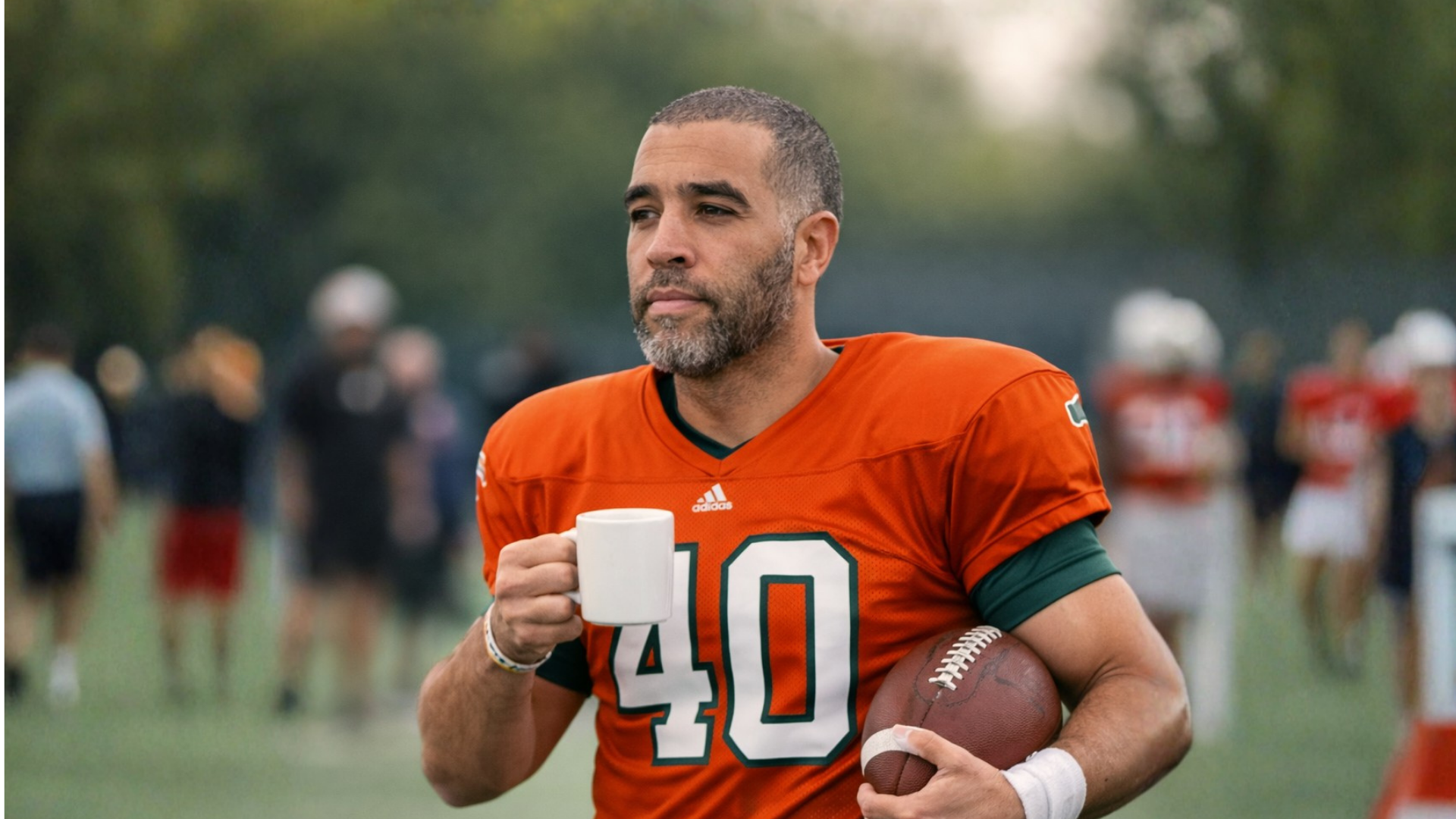
Let’s be honest.
This is what happens when you’re in the off season and missing football.
After starting to predict spring depth charts, debating transfer portal strategy, and watching one too many highlight compilations, the question appeared:
Could I, a 40-year-old British man, technically walk on to an NCAA Division I football team?
It sounds like a punchline.
But when you actually examine the NCAA rulebook, the answer is not an immediate no.
Step One: Is There an Age Limit?
Short answer: no.
The NCAA does not impose a maximum age for participation in Division I football. There is no written rule that says you must be under 25, under 30, or under any specific age to compete.
Eligibility is governed by:
- Academic status
- Seasons of competition
- Enrolment history
- Amateurism certification
Age alone is not disqualifying.
Which is where the danger begins.
Step Two: The Five-Year Clock
Under NCAA Division I Bylaw 12.8, once a student enrols full-time at a collegiate institution, they have five calendar years in which to compete in four seasons of a sport.
This is known as the five-year clock.
The clock begins when you enrol as a full-time student.
Not when you leave school.
Not when you turn 18.
Not when you realise stretching has become mandatory.
So, in theory:
If you have never previously enrolled full-time at a US college or university, and you are admitted and certified academically by the NCAA Eligibility Centre, your five-year window begins at that point.
That means a 40-year-old freshman is not automatically ruled out.
Technically.
Step Three: Academic Eligibility
This is where things get more complex.
Before competing, student-athletes must be certified by the NCAA Eligibility Centre. That includes:
- Proof of academic qualifications
- Completion of core coursework requirements
- Amateurism certification
- Confirmation of full-time enrolment
For a British applicant, that would likely involve transcript evaluation, qualification equivalency review, and institutional acceptance into a degree programme.
So before you even get near a try-out, you are effectively applying to university.
At 40.
For football.
That alone might require a documentary.
Step Four: Organised Competition Rules
The NCAA also regulates participation in organised competition after high school.
In some sports, prolonged organised competition without collegiate enrolment can reduce seasons of eligibility. Football has amateurism and participation standards that prevent players from essentially delaying college for professional-style development.
However, unless you have been actively competing in organised American football in a way that violates amateurism principles, this is unlikely to be the decisive barrier.
For most adults, the real barrier is not regulatory.
It is physical.

The Era of the Perpetual Senior
Modern college football has made this discussion feel less ridiculous than it should.
Between redshirt seasons, medical hardship waivers, graduate transfers, and the additional year of eligibility granted during the COVID-19 pandemic, extended careers have become normal.
Sixth-year seniors are common.
Seventh-year players are not shocking.
In rare cases, eligibility has stretched towards eight or even nine years in the system.
Every season, commentators introduce someone as:
“Here he is, in his seventh year of college football.”
At that point, the idea of an older freshman stops sounding entirely fictional.
College football eligibility is not endless.
But it has become elastic.
The Physical Reality
This is where theory meets biology.
Division I football players are elite athletes. They are:
- Faster
- Stronger
- More explosive
- More conditioned
Even the third-team safety likely ran a sub-4.6 forty at 18.
At 40, the issues are not desire or belief.
They are:
- Recovery time
- Soft tissue durability
- Acceleration
- Reaction speed
Even assuming full fitness and serious preparation, you are competing against players in their physical prime.
And that is before conditioning drills.

So What Position Makes Sense?
Let’s remove the fantasy positions immediately.
Quarterback requires elite arm talent and timing.
Running back requires collision tolerance and acceleration.
Wide receiver requires separation speed.
Cornerback requires elite change of direction.
Linebacker requires absorbing blocks from 140kg linemen.
Which leaves the one role that narrows the gap between absurd and theoretically conceivable.
Kicker.
Specialists rely heavily on:
- Technical consistency
- Muscle memory
- Composure under pressure
- Repetition and refinement
Not repeated high-speed collisions.
Would you still be competing against trained, younger specialists? Of course.
But if there is a position where age is less catastrophic, it is special teams.
Minimal contact. Maximum pressure.
Very cinematic.
The Honest Verdict
On paper:
Yes, there is no age rule automatically disqualifying a 40-year-old.
Yes, if you have never started your five-year clock, you could technically begin one.
In reality:
You would need admission to a US university.
NCAA academic and amateurism certification.
Elite physical preparation.
A coaching staff willing to entertain the experiment.
And even then, surviving conditioning might be the biggest challenge.
Technically possible.
Practically improbable.
Still entertaining to explore.
The Last Word from Across the Pond
The off-season invites dangerous thoughts.
It makes you overanalyse what’s going to happen at spring camp. It makes you believe anything is possible. It makes you imagine lining up in orange and green under stadium lights.
So here it is.
If there is a college football programme willing to offer a 40-year-old British fan a specialist try-out, I am available.
I bring maturity, punctuality, and hydration strategy built around Yorkshire Tea.
And if any streaming platforms are reading this, “Freshman at 40” practically writes itself.
Four seasons of eligibility.
One very questionable hamstring.

Note: This article is a fictional “what if” feature imagining what would happen if I tried to walk on to the Miami Hurricanes Football team. Images used within the article are AI-generated creative illustrations designed to support the concept.
